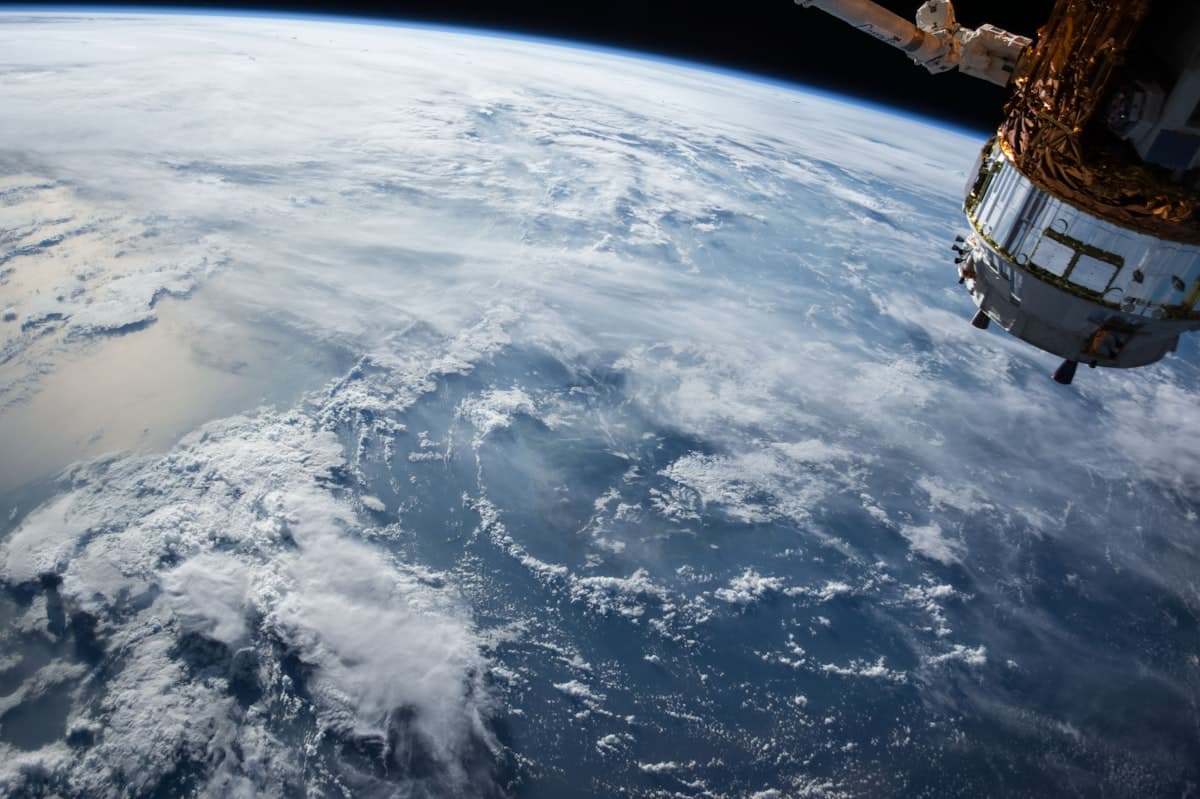
SpaceX just announced one of the most significant moves in the history of space telecommunications: it will move 4,400 Starlink satellites from their current 550km orbit to a new altitude of 480km. This change, affecting 50% of the entire constellation, isn't a routine technical upgrade. It's a direct response to a crisis the space industry has been trying to minimize for years.
Why SpaceX Is Making This Decision Now
The decision comes just days after China filed a formal complaint with the UN Security Council on January 2, 2026. Beijing accused Starlink of representing "pronounced security risks" to global orbital stability.
The cited incidents are alarming:
- 2021: Two dangerous approaches between Starlink satellites and China's Tiangong space station, forcing emergency maneuvers
- December 2025: A Starlink satellite disintegrated in orbit, generating over 100 debris fragments
- December 2025: Close approach of just 200 meters between a Chinese satellite and STARLINK-6079
The timing isn't coincidental. SpaceX responded by making moves before international pressure could escalate.
The Numbers That Reveal the Real Problem
The numbers tell a story SpaceX would rather not highlight.
Between December 2024 and May 2025, Starlink satellites performed 144,404 collision avoidance maneuvers. That's equivalent to:
- 275 maneuvers per day
- 1 collision alert every 2 minutes, 24/7
- A 200% increase compared to the previous period
According to Hugh Lewis, Professor of Astronautics at the University of Southampton, SpaceX satellites are involved in approximately 1,600 close encounters per week among spacecraft in low Earth orbit. This represents 50% of all such incidents in LEO.
And the problem is only getting worse. Lewis estimates this percentage will rise to 90% as the constellation grows.
The Ghost of Kessler Syndrome
There's a catastrophic scenario scientists have been warning about for decades: Kessler syndrome.
Proposed by NASA scientists in 1978, it describes a chain reaction where the density of objects in orbit becomes so high that collisions generate more debris, which in turn causes more collisions. The end result: certain orbits become unusable for generations.
According to Donald Kessler himself, the scientist who gave the syndrome its name: the debris environment is already unstable. Even if we stopped launching rockets today, existing debris would fragment faster than the atmosphere can clean it up.
Hugh Lewis goes further. He estimates the cumulative probability that a Starlink-sized constellation will experience at least one collision per year is greater than 10%.
"It's inevitable that we'll see a collision involving an active satellite," he warns.
SpaceX's Technical Response
SpaceX argues it's being more responsible than any other space operator. And the data partially supports this claim.
Implemented safety measures:
| Aspect | SpaceX | Industry Standard |
|---|---|---|
| Maneuver threshold | 1 in 1 million | 1 in 10,000 |
| Dead satellites in orbit | Only 2 | Variable |
| Deorbit design | 5 years without propulsion | 25 years (legal limit) |
Lowering from 550km to 480km has a clear objective: reduce deorbit time by over 80% during solar minimum. When a satellite fails, it will fall much faster instead of becoming floating debris.
Michael Nicolls, VP of Starlink Engineering, explained on X that the original 550km orbit created "congestion" with other operators and existing debris. The new 480km altitude is less populated.
The $7.7 Billion Empire
While the space safety debate continues, Starlink has become a money-making machine.
Business metrics 2024-2025:
| Metric | Value |
|---|---|
| Revenue 2024 | $7.7 billion (+83% YoY) |
| Revenue 2025 (projected) | $11.8 billion |
| Active users | 9+ million |
| Countries/territories | 155 |
| % of total SpaceX revenue | 58% in 2024, ~70% in 2025 |
| Free cash flow 2025 | ~$2 billion |
To put this in perspective: Starlink added 4.6 million new customers in 2025. At its peak growth, it was adding 21,275 new users per day.
On January 9, 2026, the FCC approved 7,500 additional Gen2 satellites, bringing the total authorized to 15,000 satellites. SpaceX originally requested nearly 30,000.
The Competition Is Far Behind
Starlink has no real rival in the current market.
| Competitor | Satellites | Annual Revenue | Status |
|---|---|---|---|
| Starlink | ~9,500 | $7.7 billion | Globally operational |
| OneWeb | 648 | €187 million | Limited B2B |
| Amazon Kuiper | ~150 | Pre-revenue | Launching 2026 |
| Qianfan (China) | In development | N/A | 15,000+ by 2030 |
Amazon faces an FCC deadline: it must have 50% of its constellation operational by July 2026. They're running very behind.
Astronomers Are Up in Arms
There's another less visible but equally important battle: light pollution.
More than 13,000 spacecraft currently orbit Earth. More than half are Starlink. And SpaceX plans to reach 42,000 satellites.
The problem is that all launched satellites exceed brightness limits set by the IAU Center for the Protection of the Dark Sky. Even with anti-reflective coatings, lower orbits of newer satellites worsen the brightness impact.
A NASA study found that virtually every image from future space observatories in LEO could be contaminated by satellite reflections.
Katherine Courtney, from the Global Network on Sustainability in Space, puts it this way: "Without astronomy, the modern space economy simply wouldn't exist. There's an urgent need for more dialogue."
What This Means for Starlink Users
If you're a Starlink user, the good news is this change will probably improve your experience.
Expected benefits:
-
Better latency: The 70km reduction (13%) will proportionally reduce transmission time. Elon Musk's target is average latency below 20ms (currently 17-25ms).
-
No interruptions: SpaceX is coordinating the descent with USSPACECOM and other operators. No significant service outages are expected.
-
Greater long-term security: Less congestion in the 550km orbit means lower risk of catastrophic collision affecting service.
Possible concerns:
- Descent maneuvers consume propellant, potentially shortening the lifespan of some satellites
- Lower orbits mean less coverage area per satellite (compensated by constellation density)
The Future: Starlink V3 and Direct-to-Cell
SpaceX isn't stopping. The Starlink V3 satellites, launching in 2026 using Starship, promise:
- Over 1 Terabit/second download (10x more than current)
- 200 Gbps upload (24x more than now)
- Satellite internet that will compete directly with fiber optics
The Direct-to-Cell service already has 6 million users in 22 countries, allowing direct connection from smartphones without an antenna.
The Big Question: Is It Sustainable?
Space isn't infinite. Or more precisely, useful orbits aren't.
The ESA estimates there are 131 million fragments of space debris between 1mm and 10cm orbiting Earth at average speeds of 36,000 km/h. At that speed, a marble-sized fragment can destroy a satellite.
SpaceX argues it's being responsible: its satellites will deorbit quickly, they have only 2 dead satellites out of 9,500, and they proactively maneuver to avoid collisions.
But critics point out that the scale itself is the problem. A constellation of 42,000 satellites fundamentally changes orbital dynamics, regardless of how responsible each individual satellite is.
The international community is starting to take notice. Beyond China's UN complaint, the European Space Agency has called for binding international regulations on mega-constellations. The UK Space Agency has proposed a "space sustainability levy" on satellite operators. And NASA has quietly begun studying the long-term implications of commercial mega-constellations for future exploration missions.
SpaceX's decision to lower its satellites may be just the first of many forced adaptations as the industry grapples with the reality that orbital space is a finite resource that requires careful management.
Conclusion: An Unprecedented Global Experiment
SpaceX's decision to lower 4,400 satellites is significant for what it reveals: even the world's most sophisticated operator recognizes the status quo isn't sustainable.
Pressure from China, warnings from scientists, and increasingly concerning collision numbers are forcing the industry to adapt.
For users, Starlink remains the best satellite internet option available. For the planet, the verdict on whether we can fill the sky with satellites without catastrophic consequences is yet to be determined.
What's certain is that we're living through an unprecedented global experiment. And the consequences, good or bad, we'll see in the coming decades.